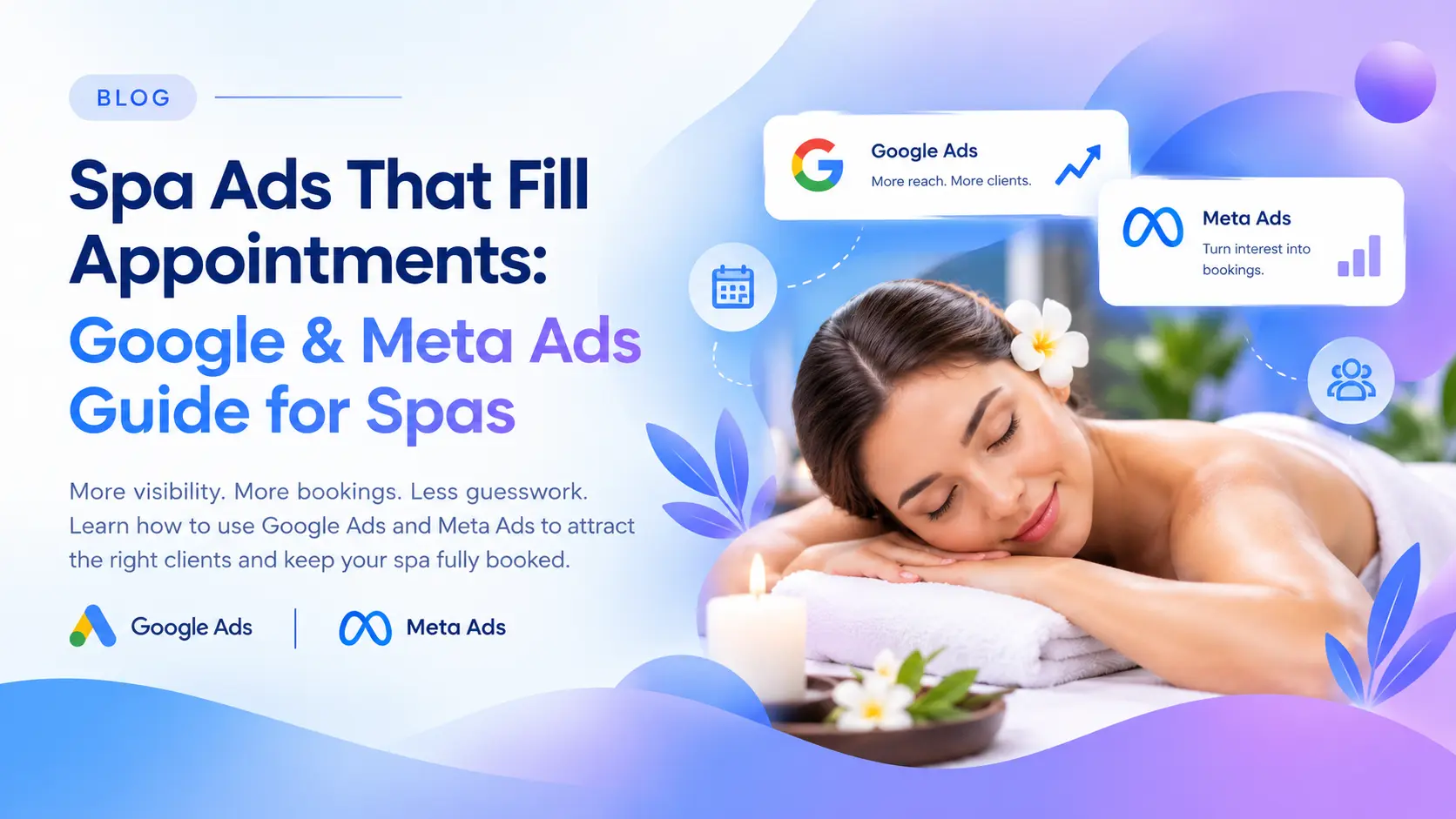
Quick answer: The most reliable way to get spa bookings from ads is to run Google Search Ads for people actively searching for spa services near them, and Meta (Facebook and Instagram) Ads with click-to-WhatsApp messages to reach nearby people who are not searching yet. Target a tight radius around your spa, keep every ad and image professional so it passes ad review, send traffic to a page or chat that makes booking easy, and track bookings rather than clicks.
Key takeaways
- Google Ads captures demand. People typing “spa near me” or “deep tissue massage in Secunderabad” are ready to book today.
- Meta Ads creates demand. Relaxing visuals and first-visit offers reach people within a few kilometres of your spa before they search.
- Policy compliance is make-or-break. Spa and massage ads are reviewed closely, so suggestive words or images get ads rejected and can put the whole account at risk.
- WhatsApp is the best conversion point in India. Most spa customers prefer to message before booking, so click-to-WhatsApp and call ads usually outperform long forms.
- Measure bookings, not likes. Track calls, WhatsApp chats and confirmed appointments, then move budget to what fills the calendar.
Why do spas need paid advertising?
Spa bookings are local and impulsive. Most customers decide within a day or two, choose a spa within a short drive, and pick whoever looks trustworthy and replies first. Organic SEO and your Google Business Profile build long-term visibility, but paid ads put you in front of customers today, on the exact searches and in the exact neighbourhoods that matter.
From managing campaigns for wellness spas in Hyderabad, the pattern is consistent: spas that combine search ads, social ads and a well-maintained Google Business Profile get steadier weekday bookings than spas that rely on walk-ins or a single channel.
How should a spa set up Google Ads?
Google Search Ads work because they match intent. Someone searching “couples spa package Banjara Hills” has already decided what they want; your job is to be the clearest, most trustworthy option.
1. Structure campaigns by service
Create separate ad groups for your main services so each ad matches the search closely:
| Ad group |
Example keywords |
Why it works |
| Spa near me |
spa near me, best spa in [area], day spa [city] |
High-intent local searches |
| Massage types |
swedish massage [area], deep tissue massage [city], aromatherapy massage |
Customer knows the treatment |
| Packages |
couples spa package, spa day package, bridal spa package |
Higher order value |
| Facials and body care |
facial near me, body scrub [city], head massage [area] |
Additional services |
Use phrase match and exact match for core terms, and add your neighbourhood names. Broad match can work later once conversion tracking has enough data.
2. Add negative keywords from day one
Negative keywords stop wasted spend on searches that will never book. Common ones for spas include jobs, salary, vacancy, course, training, certification, school, DIY, at home, oil price, machine, chair and free. Review the search terms report every week and keep adding to the list, including anything that suggests services you do not offer.
3. Write ads that build trust
A strong spa search ad answers three questions instantly: what you offer, where you are, and why you are safe to choose.
Example headline set: Relaxing Spa in Secunderabad | Certified Therapists | Book on WhatsApp Today
Example description: Swedish, deep tissue and aromatherapy massages in a clean, private setting. Open 7 days. Easy parking. Message us to book your slot.
4. Use every relevant asset
- Call assets so mobile users can call in one tap.
- Location assets linked to your Google Business Profile so your address and distance show.
- Sitelinks to your services, packages, prices and contact page.
- Price assets for your most popular treatments, if you publish prices.
- Callouts such as “Certified therapists”, “Hygienic rooms” and “Open 7 days”.
5. Target a realistic radius
Most spa customers will not travel far. Start with a radius of roughly 5 to 8 km around the spa, or a list of the neighbourhoods you actually serve, and set location targeting to people in or regularly in your target area rather than people merely interested in it.
Meta Ads reach people before they start searching. They work best for new-customer offers, packages and festive promotions.
Choose the right objective
- Engagement with Messages (click-to-WhatsApp): usually the strongest option for Indian spas, because customers want to ask about timing, therapists and prices before booking.
- Leads (instant forms): useful for package enquiries; keep the form short with name, phone number and preferred date.
- Awareness or reach: only for launches or festive campaigns, and always alongside a conversion campaign.
Audience targeting
Begin with a tight location radius around your spa and broad interests such as wellness, self-care and beauty. Then build retargeting audiences from website visitors, Instagram engagers and people who watched your videos. These warm audiences usually book at a much lower cost than cold audiences.
Creatives that work for spas
- Short videos of your actual rooms, reception and hygiene routine.
- Therapists in uniform preparing a treatment room, not close-ups of bodies.
- Clear offer text: “First visit: complimentary head massage with any 60-minute treatment”.
- Real customer reviews shown as text, with permission.
Rotate creatives every few weeks; spa audiences tire of the same visuals quickly.
What gets spa ads disapproved?
This is where many spa campaigns fail. Massage and spa ads are reviewed carefully under both Google’s and Meta’s adult-content rules, and repeated violations can suspend an entire ad account.
Avoid:
- Suggestive or ambiguous phrases, including any wording that hints at services beyond legitimate therapy.
- Images that focus on bare skin or body parts, or that look sensual rather than therapeutic.
- Claims of medical cures, such as “cures back pain” or “treats arthritis”, unless provided by licensed medical professionals.
- Landing pages that are thin, contain such wording, or do not clearly show a genuine business address and services.
Do:
- Use clinical, professional language: “therapeutic massage”, “certified therapists”, “wellness treatments”.
- Show your premises, team and hygiene standards.
- Keep your website, Google Business Profile and ads consistent in name, address and phone number.
Read the current rules before launching, as they change: see the Google Ads policies and Meta Advertising Standards.
How much should a spa spend on ads?
There is no single right number, because costs vary by city, competition and season. Work backwards from your goal instead:
- Decide how many new bookings you want each month.
- Estimate what one new booking can cost while staying profitable, considering repeat visits.
- Multiply the two to get a starting monthly budget, then split it between Google and Meta.
Illustrative example: if you want 40 new bookings a month and can afford ₹500 per new customer, start with about ₹20,000 a month. Review after four weeks and shift budget towards the channel with the lower cost per booking. These figures are an example of the method, not a benchmark for your area.
A common starting split is around 60% Google Search and 40% Meta, adjusted once real results come in.
How do you track spa bookings from ads?
Clicks do not pay the rent; bookings do. Set up tracking before you spend:
- Calls: Google call assets with call reporting, plus a tracked number on your landing page.
- WhatsApp: track clicks on WhatsApp buttons as conversions in Google Ads and GA4, and use Meta’s messaging results for click-to-WhatsApp ads.
- Forms: track successful submissions with a thank-you page or event.
- Confirmed bookings: ask every new customer how they found you and record it, then compare with ad reports each week. Where possible, upload confirmed bookings back to Google Ads as offline conversions so bidding learns what a real customer looks like.
How do ads work with SEO and AEO for spas?
Ads, SEO and answer engine optimisation (AEO) support each other:
- A complete Google Business Profile with photos, services, opening hours and steady reviews improves both Maps rankings and ad performance through location assets.
- A fast, clear website with service pages, prices and an FAQ section raises Quality Score and lowers cost per click.
- FAQ content and schema markup help your spa appear in Google’s “People also ask” results, voice search and AI answers from tools such as ChatGPT and Google AI Overviews.
- Search terms that convert well in ads show you which pages and blog topics to create for organic traffic.
What are the most common spa advertising mistakes?
- Sending ad traffic to the home page instead of a focused service or offer page.
- Targeting an entire city when customers only travel a few kilometres.
- Running one generic ad for every service.
- Using stock images that look nothing like the real spa.
- Replying to WhatsApp enquiries hours later; speed of reply directly affects bookings.
- Judging campaigns on likes, reach or clicks instead of confirmed appointments.
A 30-day launch plan for spa ads
| Week |
Focus |
Actions |
| Week 1 |
Foundations |
Update Google Business Profile, build service landing page, set up call, WhatsApp and form tracking |
| Week 2 |
Launch |
Start Google Search campaigns by service and one Meta click-to-WhatsApp campaign with a first-visit offer |
| Week 3 |
Clean up |
Add negative keywords, pause weak ads, test two new creatives, reply to every chat within minutes |
| Week 4 |
Optimise |
Compare cost per booking by channel, move budget to winners, launch retargeting for website visitors |
Final thoughts
Spa advertising works when it is local, trustworthy and easy to book from. Google Ads captures people who are ready now, Meta Ads fills the pipeline with nearby customers, and a strong Google Business Profile and website make both cheaper over time. Keep every ad professional, track real bookings, and refine every week.
If you would like a second pair of eyes on your spa’s campaigns, a free audit is a good place to start.